AI & SEO
AI Visibility: How to Get Your Content Cited by ChatGPT, Perplexity, and AI Search Engines
By Robert Belkin, Founder & Lead Strategist
Published · 10 min read
Search is changing. A growing proportion of questions that would once have gone to Google are now being answered directly by ChatGPT, Perplexity, Claude, and other AI systems. When those systems answer a question, they cite sources — and whether your content appears in those citations depends on specific, measurable signals that you can control.
Why AI Visibility Matters
AI-generated answers represent a fundamentally different distribution channel from traditional search. In a standard Google search, the user sees ten blue links and clicks one. In an AI search, the user gets a synthesised answer — and if your content contributed to that answer, your brand and URL appear in the citation list, often above any traditional search results.
The traffic dynamics are different too. AI citation traffic tends to be high-intent and highly qualified — users who followed a citation to your site are specifically interested in the source behind the answer they just read. Conversion rates on AI referral traffic are consistently higher than average organic search traffic.
The AI Visibility dimension exists because the signals that make content AI-citation-eligible are specific and technical. They overlap significantly with traditional SEO best practices — structured content, clear entities, authoritative sources — but they also include AI-specific requirements like llms.txt configuration and bot access controls that did not exist a few years ago.
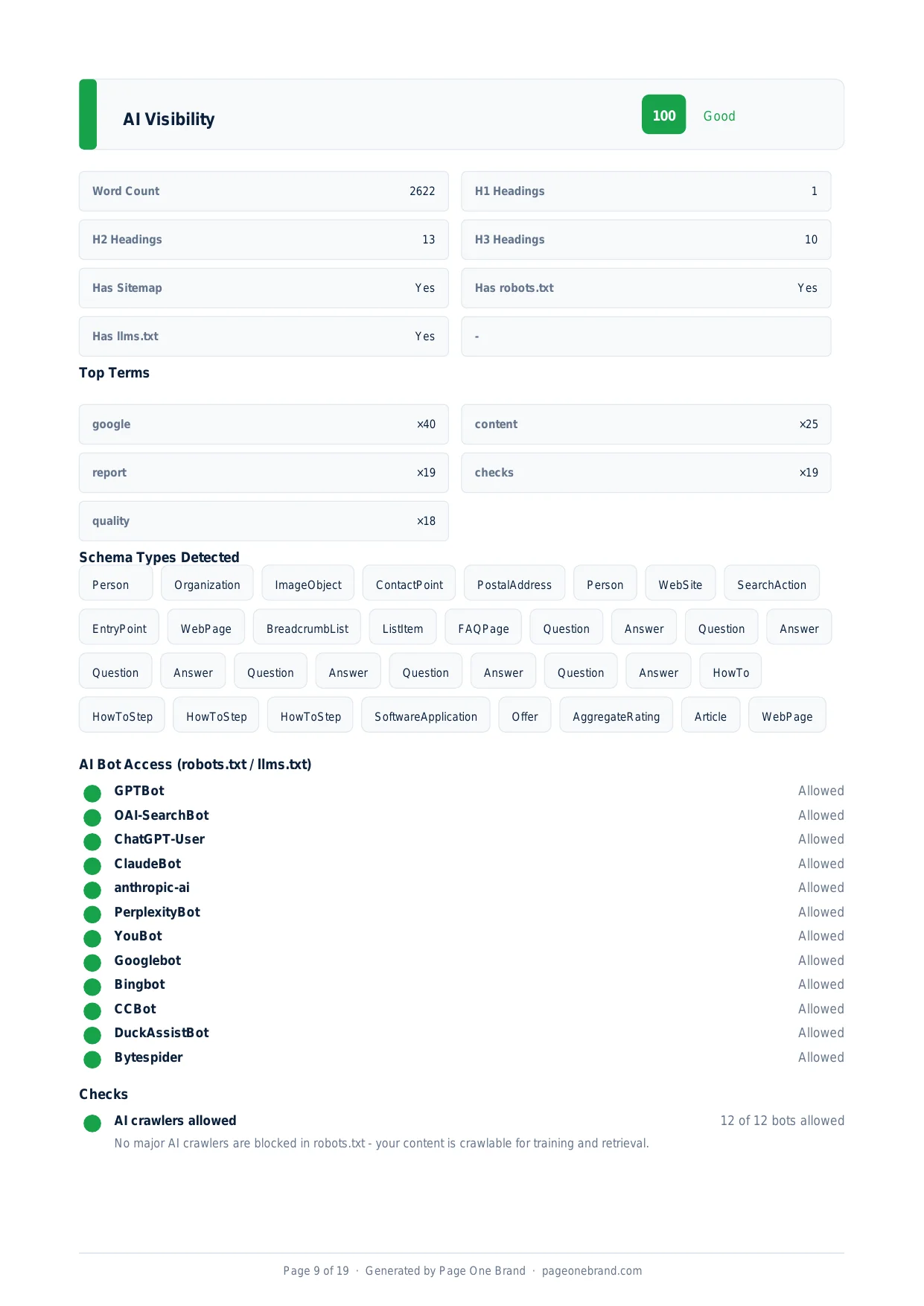
The AI Visibility section of a real scan — showing which AI crawlers are allowed access, which schema types are detected, and the content signals that influence LLM citation likelihood.
How We Calculate the AI Visibility Score
The AI Visibility score is rule-based — every check has a deterministic pass or fail. We assess six groups of signals:
- AI bot access (robots.txt and llms.txt). Twelve major AI crawlers are checked: GPTBot, OAI-SearchBot, ChatGPT-User, ClaudeBot, anthropic-ai, PerplexityBot, YouBot, Googlebot, Bingbot, CCBot, DuckAssistBot, and Bytespider. Any blocked crawler is flagged. An llms.txt file is checked for presence and length.
- Structured data richness. Pages with multiple schema types give LLMs unambiguous, machine-readable facts to anchor their answers.
- Author metadata. Author name in meta tags or schema signals that the content has a human expert behind it, which increases citation trustworthiness.
- Publication and modification dates. Date metadata tells AI systems how fresh the content is. Outdated content is less likely to be cited for time-sensitive topics.
- Heading structure. A clear H1 to H2 hierarchy with well-labelled sections helps AI systems segment and summarise your content accurately.
- Content depth signals. Word count, factual statements, concise definitions, and unique insights all make content more citation-worthy.
The llms.txt File: A New Standard Worth Implementing Now
llms.txt is an emerging convention — analogous to robots.txt — that lets site owners provide AI systems with a curated, structured overview of their content. It is a plain-text file placed at the root of your domain (/llms.txt) with a defined format: site name, purpose, and a structured list of important pages with brief descriptions.
Early adoption sends a clear signal to AI systems that you are optimised for LLM discovery — and it gives them a road map to your best content.
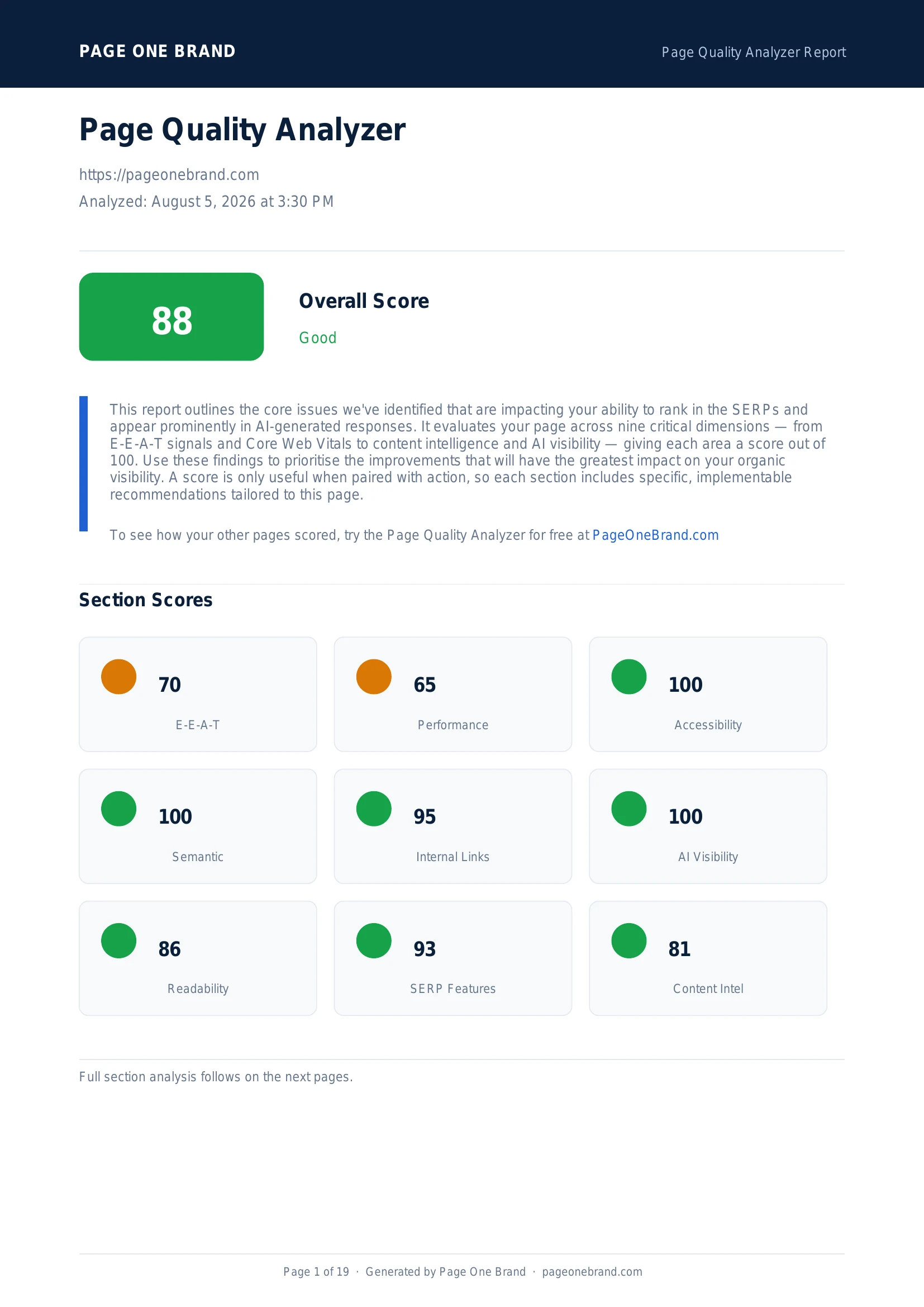 AI Visibility is one of the dimensions where early optimisation creates a lasting advantage — as AI search grows, sites with the right signals already in place will accumulate citation equity faster.
How to Improve Your AI Visibility Score
- Check your robots.txt. Search for any Disallow directives that affect AI crawlers. GPTBot, ClaudeBot, and PerplexityBot are most commonly blocked, sometimes by a plugin or platform update.
- Create an llms.txt file. Even a basic version — site name, purpose, and your most important pages — will pass this check and give AI systems a curated entry point to your content.
- Add author metadata to every page. Include author name in both meta tags and Person schema. This is one of the most direct signals that your content has identified, attributable authorship.
- Add factual statements with specifics. Replace vague claims with specific ones. AI systems prefer content with verifiable, quantified claims.
- Publish concise definitions. For every key concept your content covers, include a clear, quotable definition. These are exactly the kind of passages that get lifted into AI-generated answers.
The underlying principle is stable: make your content structured, attributable, accurate, and easy for machines to segment. Those properties have always mattered for SEO — they matter even more when the reader is an AI system synthesising answers at scale.
Frequently Asked Questions About AI Visibility
What is llms.txt and do I need one?
llms.txt is an emerging convention — analogous to robots.txt — that lets site owners provide AI systems with a curated, structured overview of their content. It is a plain-text file placed at the root of your domain (/llms.txt) that includes your site name, purpose, and a structured list of important pages with brief descriptions. AI systems that respect llms.txt use it as a road map to your best content, increasing the likelihood that they index and cite your most valuable pages. Even a basic version with five to ten page entries passes the check. Early adoption creates a lasting advantage: as AI search grows, sites with llms.txt already in place will have been discoverable for longer than sites that add it later.
Which AI crawlers need to be allowed in my robots.txt?
The twelve major AI crawlers to check are: GPTBot (OpenAI web browsing), OAI-SearchBot (OpenAI search), ChatGPT-User (ChatGPT browsing), ClaudeBot (Anthropic), anthropic-ai (Anthropic), PerplexityBot (Perplexity), YouBot (You.com), Googlebot (Google including Gemini), Bingbot (Microsoft Copilot), CCBot (Common Crawl, used for LLM training), DuckAssistBot (DuckDuckGo AI), and Bytespider (ByteDance/TikTok). The most commonly blocked by accident are GPTBot, ClaudeBot, and PerplexityBot — sometimes added to robots.txt by default by CMS plugins or platform updates. Review your robots.txt specifically for Disallow rules affecting these user agents even if you never intentionally blocked them.
How is being cited in AI search different from ranking in Google?
In traditional Google search, ranking determines where your result appears in a list of ten links. In AI search, the system synthesises an answer from multiple sources and includes citations inline. Getting cited in an AI answer does not require ranking first — it requires your content to be the clearest, most precise source for a specific factual claim or answer. AI systems prefer content that is structured, attributed, specific, and quotable: direct definitions, statistics with sources, and clear Q&A formats. A well-structured blog post that precisely answers a specific question may be cited by ChatGPT or Perplexity even if it ranks fourth on Google for a related keyword.
Does blocking AI crawlers in robots.txt affect Google rankings?
Blocking AI-specific crawlers like GPTBot or ClaudeBot does not directly affect your Google search rankings — these are entirely separate from Googlebot, which handles Google Search indexing. However, blocking AI crawlers prevents your content from being cited in AI-generated answers on ChatGPT, Perplexity, and similar platforms, which is a meaningful and growing traffic source. Googlebot and its related crawlers (Google-InspectionTool, APIs-Google) remain separate user agents — allowing GPTBot while blocking Googlebot would suppress search rankings, but blocking GPTBot while allowing Googlebot has no direct search ranking consequence.