SEO Strategy
E-E-A-T Explained: What It Is and Why Google Uses It to Judge Your Page
By Robert Belkin, Founder & Lead Strategist
Published · Reviewed by Robert Belkin · 10 min read
E-E-A-T is one of the most consequential — and most misunderstood — concepts in SEO. It stands for Experience, Expertise, Authoritativeness, and Trustworthiness, and it sits at the heart of how Google's quality raters evaluate whether a page deserves to rank.
Why E-E-A-T Matters
Google's mission is to return the most helpful, accurate, and trustworthy results for every search. To assess that at scale, Google employs thousands of human Search Quality Raters who use a detailed set of guidelines to evaluate pages. E-E-A-T is the central framework those raters apply.
It matters most on what Google calls YMYL pages — Your Money or Your Life topics. Medical advice, financial guidance, legal information, safety instructions — pages where bad information can cause genuine harm. On these topics, Google raises the E-E-A-T bar significantly. A medical explainer written by an anonymous author will consistently underperform one attributed to a named, credentialed physician, all else being equal.
But E-E-A-T is not only a YMYL concern. Google's classifiers are trained on quality rater feedback, meaning the signals that quality raters use to assess E-E-A-T translate directly into ranking factors across every topic category. Pages with strong E-E-A-T signals — verified authors, cited sources, institutional affiliations, demonstrated expertise — consistently outrank thin or anonymous alternatives.
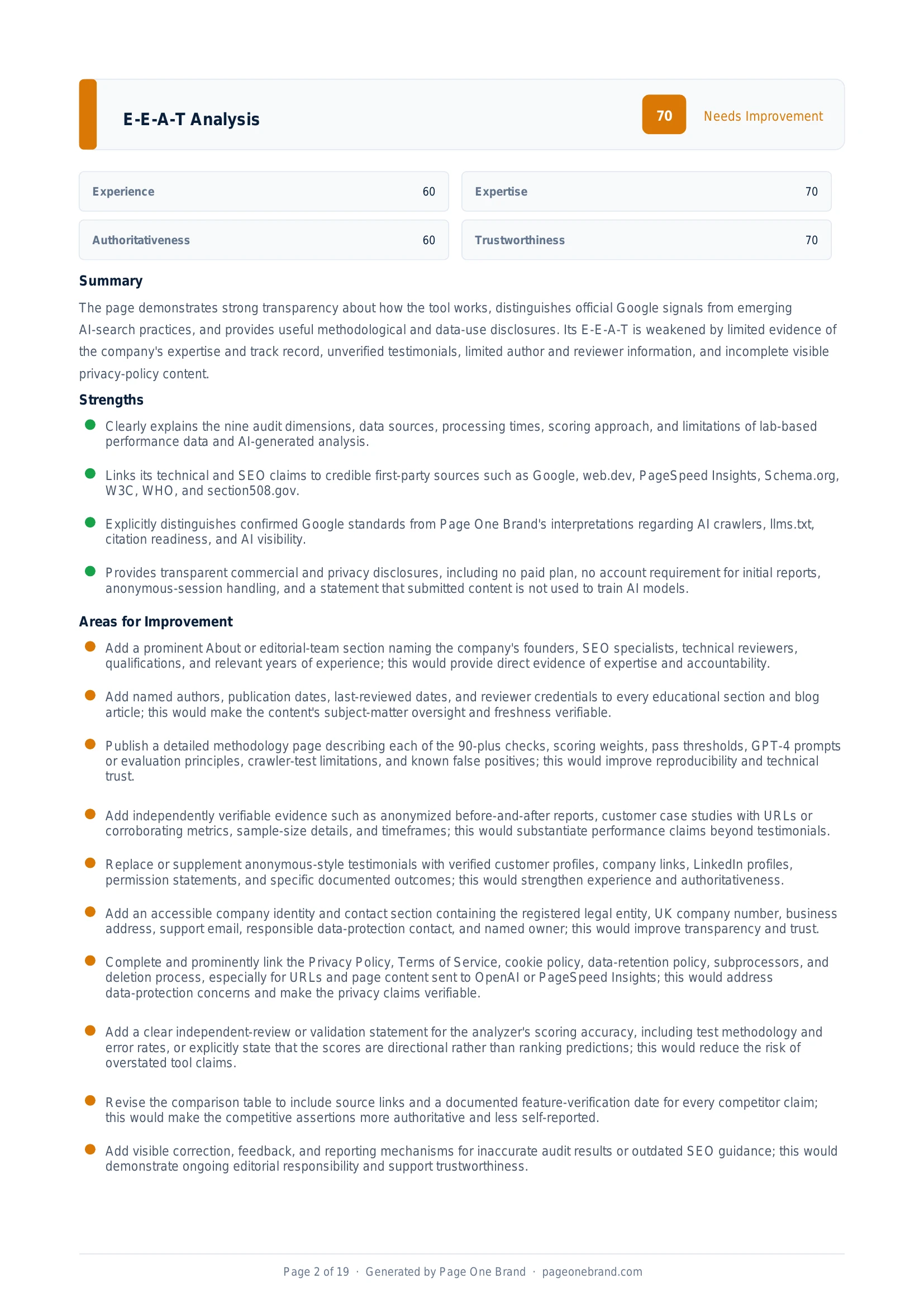
A real E-E-A-T breakdown from the Page Quality Analyzer — each sub-dimension is scored separately, making it easy to pinpoint which trust signals are missing.
The Four Dimensions of E-E-A-T
The additional E for Experience was added to the framework in December 2022. Here is what each dimension covers:
- Experience — Does the content reflect first-hand experience with the topic? A product review written by someone who actually used the product carries more weight than one synthesised from secondary sources. Case studies, original data, and personal accounts all contribute to this signal.
- Expertise — Does the author have the knowledge and skills to write authoritatively on the topic? Formal credentials matter on YMYL topics. On others, demonstrated depth — detailed explanations, methodological rigour, evidence of ongoing engagement with the subject — counts more than a title.
- Authoritativeness — Is the website or author recognised as an authority by others in the field? Third-party mentions, backlinks from credible sources, citations in other publications, and industry recognition all build authoritativeness over time.
- Trustworthiness — Can users trust the page to be accurate, honest, and safe? This includes transparency about who runs the site, clear editorial standards, accurate information, privacy policies, and the absence of deceptive design patterns.
How We Calculate the E-E-A-T Score
The Page Quality Analyzer evaluates E-E-A-T using GPT-4, prompted against Google's Search Quality Rater Guidelines. This is the same framework Google's own raters apply, which means the evaluation reflects the signals that feed Google's ranking systems.
We score each of the four sub-dimensions independently on a 0-100 scale, then combine them into an overall E-E-A-T score. The checks look at:
- Experience signals — original data, case studies, anonymised client results, first-person accounts of using products or services, and evidence that the author has direct contact with the subject matter.
- Expertise signals — named authors with stated credentials, publication dates with clear review cycles, detailed methodology explanations, cited statistics with source links, and content depth consistent with subject-matter knowledge.
- Authoritativeness signals — third-party validation, external citations, institutional affiliations, industry recognition, and the reputation of the publishing domain on the topic.
- Trustworthiness signals — company identity (registered name, address, contact), privacy policy and data handling transparency, editorial corrections mechanism, disclosure of AI use or content generation methods, and absence of misleading claims.
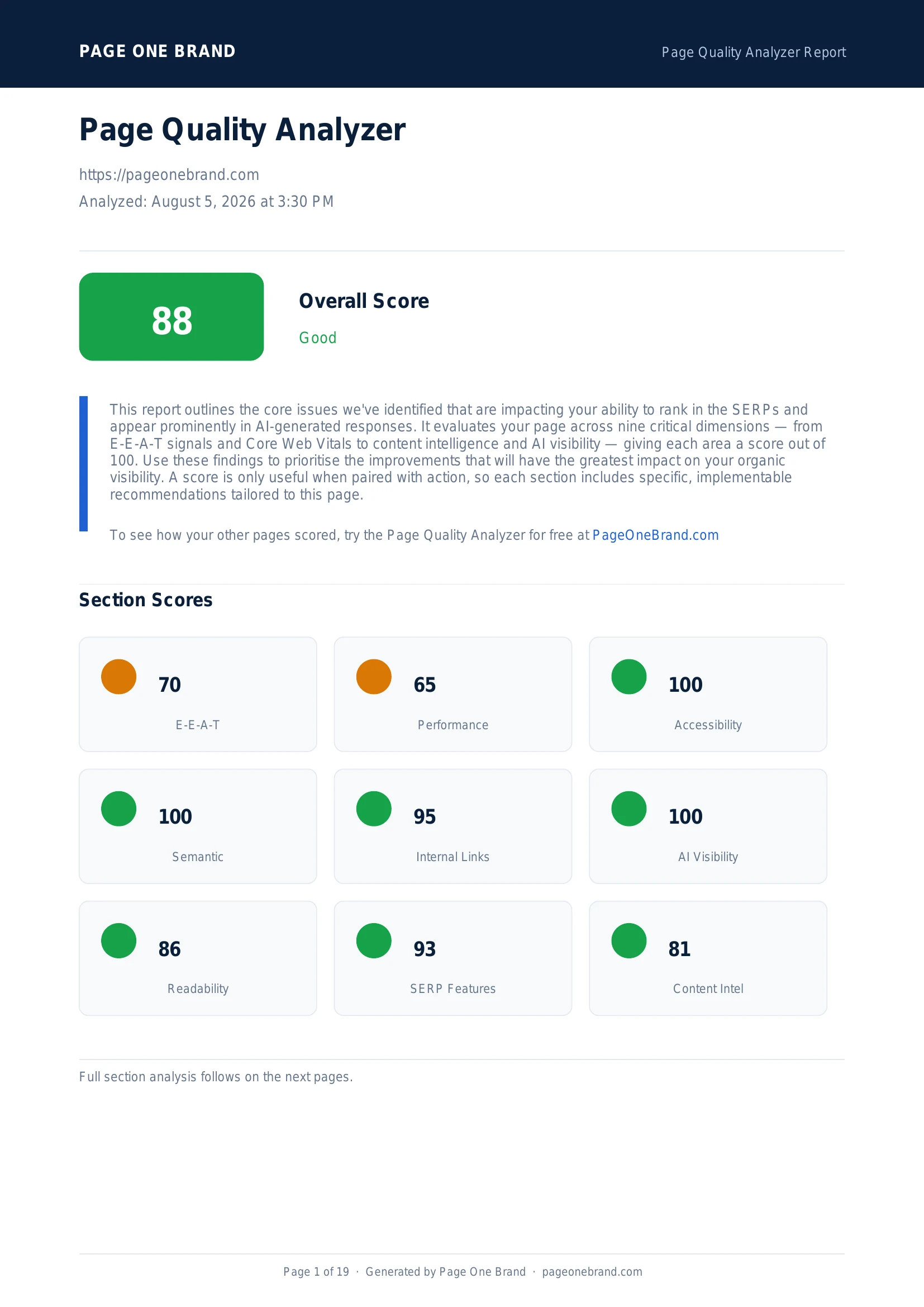 The Page Quality Analyzer scores E-E-A-T alongside eight other dimensions — E-E-A-T and Content Intelligence are the two that use GPT-4 evaluation rather than deterministic checks.
How to Improve Your E-E-A-T Score
E-E-A-T improvements tend to be slower than technical SEO fixes because most of them require business and editorial decisions, not just code changes. The highest-impact actions:
- Add named authors with verifiable credentials. Every piece of content should have a byline, a short bio, and ideally a link to an author page with professional history. For YMYL topics, credentials should be stated explicitly.
- Publish original data or case studies. First-hand evidence — client results with methodology, original survey data, documented experiments — moves the Experience sub-score more than anything else.
- Cite authoritative sources. Link out to government sites, peer-reviewed research, and recognised industry publications. Each citation signals that you engaged with credible sources rather than synthesising from thin material.
- Make your company identity verifiable. A registered business name, physical address, named leadership, and support contact all improve Trustworthiness. This information should be accessible from every page.
- Add a detailed methodology page. Explain how you do your work, how you reach your conclusions, and what your limitations are. Transparency about method is one of the strongest trust signals available.
E-E-A-T is one of the two dimensions in the Page Quality Analyzer that can never be fully improved through technical changes alone. It reflects the real-world credibility of the people and organisation behind the content — and building that credibility takes time.
Frequently Asked Questions About E-E-A-T
What does E-E-A-T stand for and when did it change?
E-E-A-T stands for Experience, Expertise, Authoritativeness, and Trustworthiness. The original framework was E-A-T — three factors. Google added the first E for Experience in December 2022, recognising that first-hand experience with a topic is a distinct quality signal from expertise alone. A product review written by someone who has actually used the product carries more weight than one synthesised from secondary sources. The addition reflected a growing concern about AI-generated content that could demonstrate surface expertise without genuine engagement with the subject matter. The full four-factor E-E-A-T framework has been in effect since late 2022.
What are YMYL pages and why does E-E-A-T matter more for them?
YMYL — Your Money or Your Life — refers to pages where inaccurate or misleading information could cause serious harm: medical advice, financial guidance, legal information, and safety instructions. Google applies a significantly higher E-E-A-T standard to YMYL pages because the consequences of bad information are severe. A medical explainer written by an anonymous author will consistently underperform one attributed to a named, credentialed physician on YMYL queries. Non-YMYL content has a lower E-E-A-T threshold, though the framework applies across all topics — YMYL simply raises the bar for what counts as sufficient expertise and trustworthiness.
How does Google actually use E-E-A-T to affect rankings?
Google does not use E-E-A-T as a direct algorithmic signal the way it uses Core Web Vitals or keyword matching. Instead, it uses E-E-A-T as a framework for training its quality classifiers: thousands of Search Quality Raters apply the E-E-A-T guidelines to evaluate pages, and that feedback trains Google's ranking systems. The result is that the signals raters look for — named authors with verifiable credentials, cited sources, company transparency, original data — become signals the algorithm has learned to reward. E-E-A-T is the intent; the ranking signals are the implementation, refined continuously through ongoing quality rater evaluation.
What is the fastest way to improve an E-E-A-T score?
The highest-impact E-E-A-T improvement is adding named authors with verifiable credentials. Every piece of content should have a byline, a short bio, and a link to an author page with professional history. This single change addresses the Expertise and Authoritativeness sub-dimensions simultaneously. The second-fastest improvement is adding cited sources — linking to government sites, peer-reviewed research, and recognised industry publications. Citations signal that you engaged with credible sources and give readers a way to verify your claims. Both are content and editorial decisions rather than code changes, which is why E-E-A-T improvements are slower to implement than technical SEO fixes but have a more durable impact on rankings.
Editorial implementation brief · SEO
An E-E-A-T brief that an editor can actually approve
E-E-A-T is not a badge or a score Google publishes for a page. Treat it as a quality framework: show who did the work, what they know, what they observed, and how a reader can verify important claims.
What to check, in order
- Assign a named author with a relevant profile and explain the author’s first-hand experience.
- For YMYL topics, add an appropriately qualified reviewer and make the review scope and date explicit.
- Cite primary sources beside claims, especially standards, official documentation, and original research.
- Add an original example, test, dataset, or limitation; do not imply client results that cannot be verified.
- Link the article to the About page, methodology, and a reachable contact or correction route.
Copy-paste example
<article>
  <p class="byline">By Robert Belkin · Reviewed August 25, 2026</p>
  <p class="evidence">Tested on a production page with Lighthouse mobile mode.</p>
  <a href="https://developers.google.com/search/docs/fundamentals/creating-helpful-content">
    Verify the underlying guidance
  </a>
</article>
Evidence from our workflow
We distinguish an observation from a general claim in our editorial review: an observation includes the URL or test setup, date, and limitation; a general claim links to the primary source. The analyzer’s AI-assisted score is labelled as an interpretation, not presented as a Google ranking signal.
Primary sources
Editorial note: This guide was written by Robert Belkin, Founder & Lead Strategist at Page One Brand, and technically reviewed by Robert Belkin on August 25, 2026. See the author profile, scoring methodology, and contact page for supporting business and editorial information.