SEO Strategy
SERP Feature Readiness: How to Earn Featured Snippets, Rich Results, and People Also Ask
By Robert Belkin, Founder & Lead Strategist
Published · 11 min read
A standard search result shows a title, URL, and description. A page that has earned SERP features shows much more — star ratings, expandable FAQs, step-by-step instructions, breadcrumb paths, or a featured snippet that appears above all other results. SERP features typically double or triple click-through rates compared to standard listings at the same position.
Why SERP Feature Readiness Matters
Earning a SERP feature is effectively a free upgrade to your search listing. Without changing your rank position, you can go from a standard blue link to a result that occupies dramatically more real estate on the search results page, includes visual elements, and answers user questions directly.
People Also Ask boxes — the expandable question-and-answer modules that appear frequently in Google results — often feature content from pages ranked third through tenth position. A well-optimised answer on a page ranked sixth can appear above results ranked first and second when Google selects it for a PAA box. SERP features partially decouple visibility from pure ranking.
Featured snippets — the zero-position result that shows a direct answer at the top of the page — capture an average of 35-40% of clicks for the queries where they appear. Earning one is the single highest-leverage SERP improvement available without a rank change.
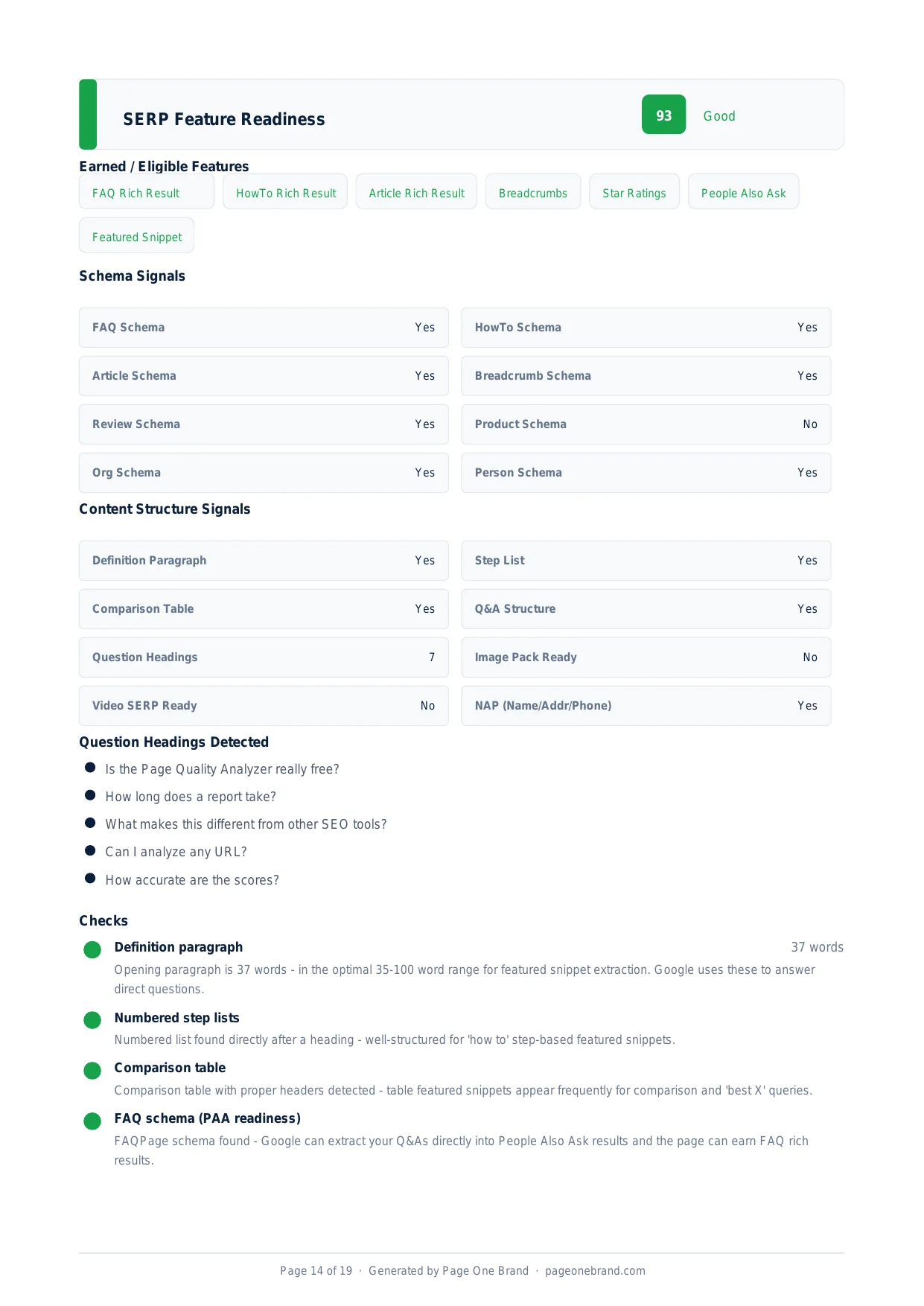
The SERP Feature Readiness section of a real scan — showing which rich results the page is eligible for, which schema types are present, and which content structure signals support further feature eligibility.
How We Calculate the SERP Feature Readiness Score
Schema signals:
- FAQPage schema. Valid FAQPage JSON-LD allows Google to extract Q&A pairs for FAQ rich results or People Also Ask boxes. This is the single highest-value schema addition for most content pages.
- HowTo schema. For step-by-step content, enables a rich result showing individual steps directly in the SERP.
- Article or BlogPosting schema. Associates the content with a publication date and author — required for Google News eligibility.
- BreadcrumbList schema. Displays the navigation path below your URL in search results and consistently improves click-through rates.
- AggregateRating schema. Displays star ratings directly in search results. Listings with star ratings regularly see 15-30% higher click-through rates.
- VideoObject schema. For pages with embedded video, enables a video rich result with a thumbnail visible directly in the SERP.
Content structure signals:
- Definition paragraph. The opening paragraph (35-100 words) is the primary candidate for a featured snippet. It should directly and concisely define or answer the page primary topic.
- Numbered step lists. Ordered lists immediately following a heading are strongly associated with HowTo featured snippets.
- Comparison tables. Data tables with proper headers are candidates for table featured snippets, which appear in response to "best X", "compare X and Y", and pricing queries.
- Question-format headings. H2 or H3 headings written as questions are the primary mechanism for People Also Ask placement. Each question heading is a potential PAA candidate.
- Direct Q&A structure. A question heading followed immediately by a paragraph that answers the question dramatically increases PAA eligibility.
The Highest-Impact SERP Feature to Pursue First
If you want the fastest SERP feature win, pursue FAQPage schema with question headings. The pattern:
- Identify three to five questions your page answers that people also search for
- Write each as an H2 or H3 heading in question form
- Follow each with a paragraph that directly answers the question in two to four sentences
- Add FAQPage JSON-LD structured data marking up the same questions and answers
This single change can earn both FAQ rich results and PAA placement — and it also improves the Readability score (question headings are excellent navigational aids) and AI Visibility score (direct Q&A is the format LLMs most prefer to cite).
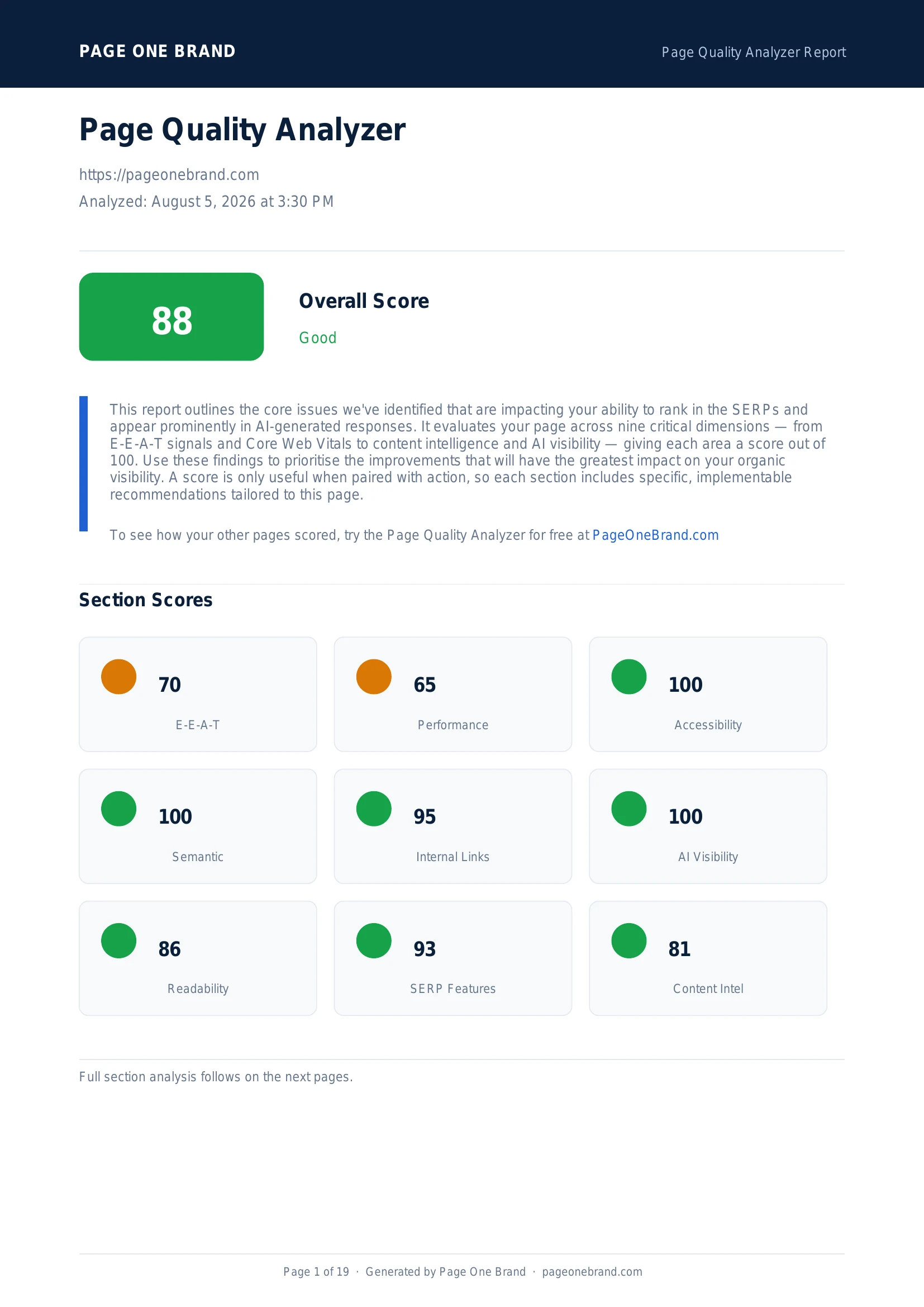 SERP Feature Readiness scored 93 in this report — already earning FAQ, HowTo, Article, Breadcrumb, and People Also Ask features. The remaining gap is primarily video rich results and image pack eligibility.
How to Improve Your SERP Feature Readiness Score
- Add FAQPage schema. Choose five to eight questions, write concise answers, and implement the JSON-LD. Use Google's Rich Results Test to verify validity before publishing.
- Rewrite your opening paragraph. It should directly answer the page primary query in 35-100 words. Think of it as a Wikipedia-style lead.
- Convert step-based content to numbered lists. If any of your content describes a process, convert the prose description into an ordered list.
- Add BreadcrumbList schema. A five-minute implementation with consistent CTR uplift. Every page should have it.
- Add a table. A comparison table, pricing table, or structured feature list is both a rich result opportunity and a content richness signal.
- Write question headings. Identify places where a section answers a specific question. Rewrite the heading as that question. Each one becomes a PAA candidate.
SERP features reward pages that are already well-organised and helpfully written. Most of the improvements that earn them are improvements that make the page genuinely better — not gaming mechanisms that work against user experience.
Frequently Asked Questions About SERP Feature Readiness
What is a featured snippet and how does my page earn one?
A featured snippet is a zero-position result that appears at the top of Google search results, showing a direct answer to the query before any ranked links. It captures an average of 35-40% of clicks for the queries where it appears. Pages earn featured snippets by having a concise definition paragraph in the opening 35-100 words that directly and completely answers the page's primary query. Writing this paragraph like a Wikipedia-style lead — one to three clear sentences that define or answer the topic — is the most reliable signal for snippet selection. The definition paragraph is the primary candidate for extraction, so it should stand alone as a useful answer even without the surrounding content.
What is FAQPage schema and how does it unlock rich results?
FAQPage JSON-LD is structured data that marks up question-and-answer pairs on your page so Google can extract them for FAQ rich results or People Also Ask boxes. A valid FAQPage schema gives Google machine-readable confirmation that your page contains specific questions and their answers, rather than requiring Google to infer this from HTML. FAQ rich results expand your search listing to show multiple expandable Q&A pairs directly in the SERP, significantly increasing the real estate your result occupies without changing your rank. FAQPage is the single highest-value schema addition for most content pages — it can be implemented for any page that contains genuine questions with substantive answers.
What are People Also Ask boxes and how do I get my content into them?
People Also Ask boxes are expandable Q&A modules that appear frequently in Google results, often featuring content from pages ranked third through tenth position. A well-optimised answer on a page ranked sixth can appear above results ranked first and second when Google selects it for a PAA box. The primary mechanism for PAA placement is question-format headings — H2 or H3 headings written as questions, each followed immediately by a paragraph that answers the question in two to four sentences. Adding FAQPage JSON-LD markup for the same questions strengthens the signal further. Each question heading is a separate PAA candidate that can earn placement independently.
Does BreadcrumbList schema improve click-through rates?
Yes. BreadcrumbList JSON-LD schema displays your site's navigation path below your URL in search results, showing the hierarchy from your homepage to the current page. This helps users understand where a page sits within your site before they click, which consistently improves click-through rates. BreadcrumbList is a five-minute implementation that requires no content changes — only a JSON-LD block describing your page hierarchy. Every page on a multi-level site benefits from it, and it is one of the few schema types where the CTR uplift is measurable within weeks of deployment.