Content Strategy
Content Intelligence: The Advanced Analysis That Predicts Whether Your Content Will Rank
By Robert Belkin, Founder & Lead Strategist
Published · 11 min read
Most SEO tools measure content quality with proxies — word count, keyword density, reading level. Content Intelligence goes deeper. It assesses whether your content actually answers the question users are searching, covers the entities Google expects to see on pages about this topic, and adds information that competing pages do not already provide.
Why Content Intelligence Matters
Google's Helpful Content system — the family of signals and classifiers that assess whether content is genuinely useful — is designed to reward content that demonstrably helps users accomplish their goals. The opposite of helpful content, in Google's framing, is content created primarily to rank: optimised around keywords, padded to a target word count, covering the same ground as a hundred other pages on the topic without adding anything new.
Content Intelligence is the dimension that most directly measures what Google's quality systems are trying to assess. It is why a 2,000-word article on a topic can outrank a 10,000-word article on the same topic — if the shorter piece covers the right entities, matches the search intent precisely, and includes information that the longer piece misses.
It is also — along with E-E-A-T — the dimension most strongly correlated with long-term organic performance. Content that scores well on Content Intelligence tends to rank, hold rankings over time, earn natural links, and get cited by AI systems.
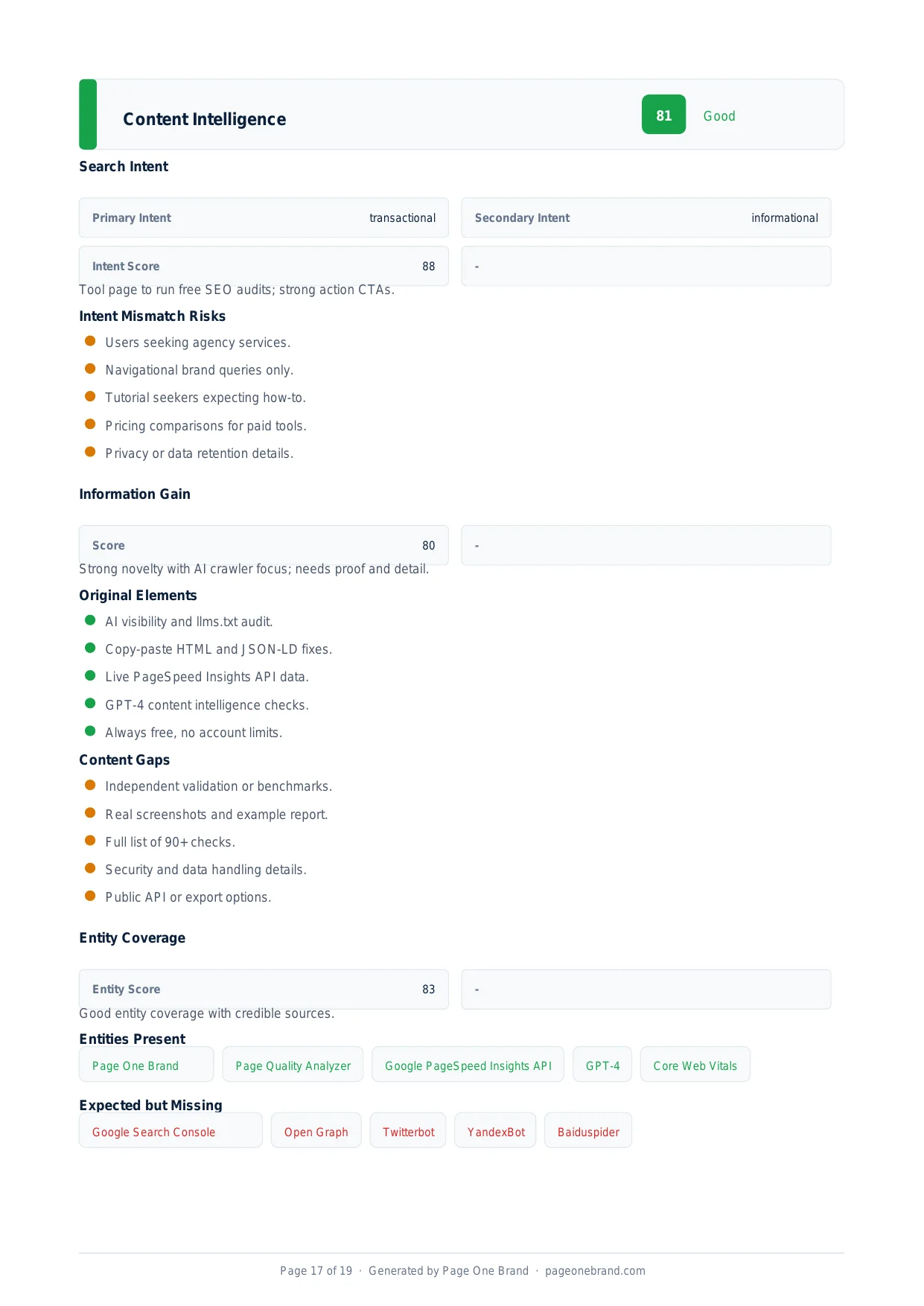
The Content Intelligence section of a real scan — showing GPT-4 evaluation of search intent match, information gain, entity coverage, and the content gaps and opportunities identified.
How We Calculate the Content Intelligence Score
Content Intelligence is evaluated by GPT-4, prompted to assess the page against five dimensions:
Search Intent (0-100): Does the content match what users are actually looking for? Google classifies intent as informational, navigational, transactional, or commercial investigation. Pages that mismatch their intent consistently underperform regardless of technical SEO quality.
Information Gain (0-100): Does the content add something not available on the top-ranking pages? Google's Information Gain patent describes a scoring mechanism that rewards content with unique angles, original data, perspectives not found elsewhere, or novel synthesis of existing information.
Entity Coverage (0-100): Entities — named concepts, people, organisations, places, products — are how Google understands what a page is about. Every topic has a set of entities that Google expects to see on high-quality pages about it. Missing key entities signals incomplete coverage.
Topical Authority (0-100): Does the page demonstrate deep engagement with the subject? Topical authority is built through coverage breadth (addressing multiple subtopics), coverage depth (exploring subtopics with specificity), and consistency (the overall site demonstrating expertise in the domain).
Competitive Depth (0-100): How does the content compare to what is already ranking? This assesses whether the page would stand out in its competitive context — offering more value, more specificity, more originality, or a meaningfully different perspective.
The Content Gaps That Most Often Suppress This Score
- Intent mismatch. The most common failure mode. A page targeting an informational query is structured as a product pitch, or a transactional page leads with a long educational introduction before reaching the offer.
- Low information gain. The content covers the same ground as the top-ranking pages with no differentiation. Pages like this compete on technical SEO signals alone — a losing long-term strategy.
- Missing entities. The page discusses a topic but omits the related concepts, tools, standards, or organisations that a comprehensive treatment would include. An article about Core Web Vitals that does not mention PageSpeed Insights, CrUX, or Lighthouse has notable entity gaps.
- Shallow subtopic coverage. The page lists subtopics but does not explore any of them in depth. Surface-level coverage signals to Google that the author understands the topic exists but not the substance of it.
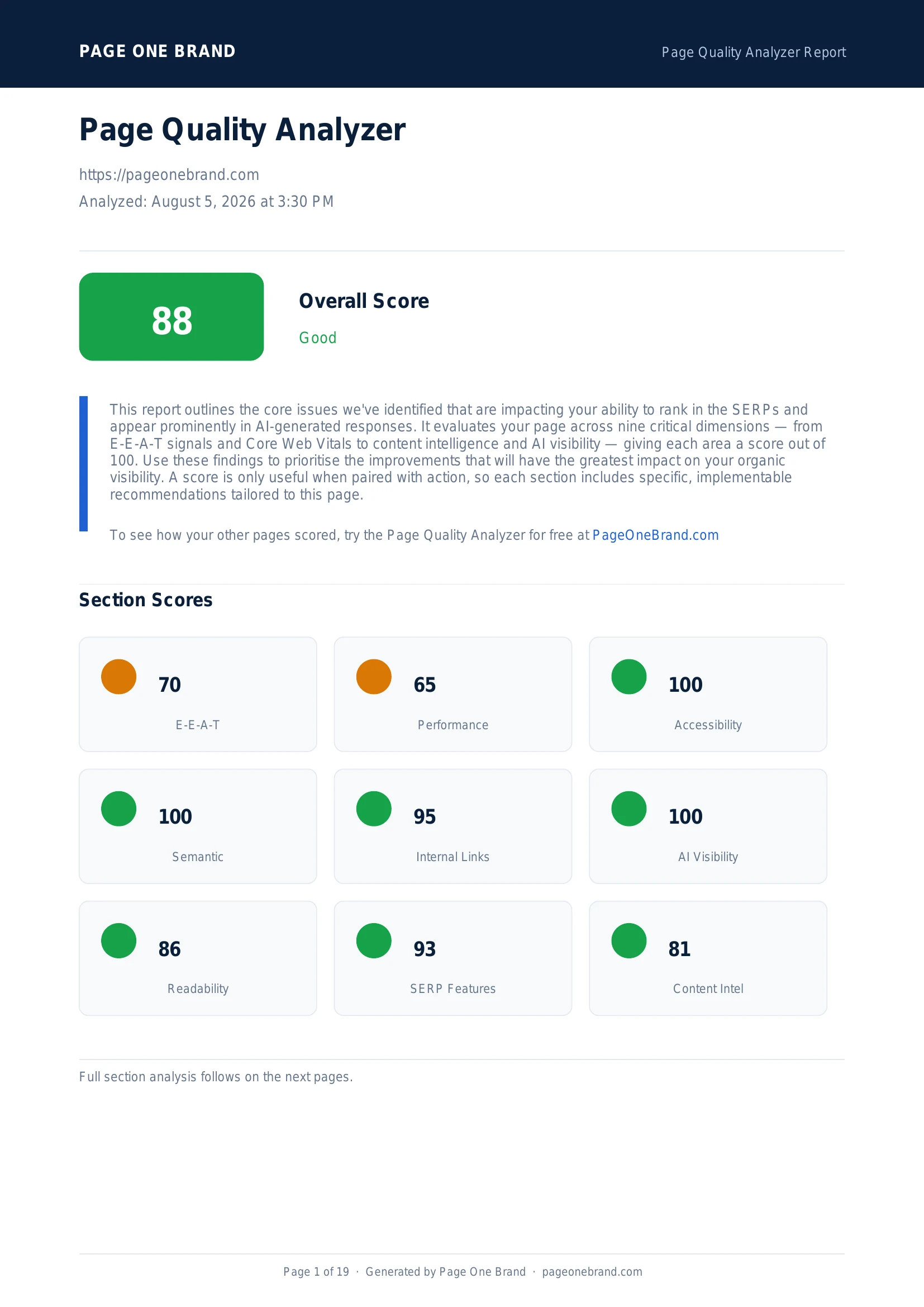 Content Intelligence and E-E-A-T are the two dimensions evaluated by GPT-4 rather than deterministic rules — which means they reflect the same qualitative signals Google's own quality systems assess.
How to Improve Your Content Intelligence Score
- Audit your intent match first. Before writing or editing, be clear about what the user wants when they search your target queries. Use the SERP itself as a guide: are the top results mostly guides, mostly product pages, mostly comparisons? Match the dominant format.
- Find your unique angle. What can you add to this topic that is not already in the top ten results? Original data, a case study, a proprietary framework, a point of view based on direct experience — any of these raises information gain meaningfully.
- Use the entity gaps section of your report. The Content Intelligence section identifies entities expected for your topic that are missing from your page. Adding substantive coverage of those entities improves both entity coverage and topical authority simultaneously.
- Deepen your subtopic coverage. Pick the two or three subtopics most relevant to your page and go deeper. Add a specific example, a numbered framework, a table of comparisons, an explanation of edge cases. Depth signals authority.
- Publish original data. A survey, an analysis of your platform data, a documented experiment — any original data point gives you something no competing page can replicate.
Content Intelligence is the dimension that separates content built to rank from content built to be genuinely useful. Closing the gap does not require SEO tricks — it requires doing the editorial work to make your content the best available answer to the questions your audience is asking.
Frequently Asked Questions About Content Intelligence
What is information gain in SEO and why does Google reward it?
Information gain is a concept from Google's ranking research that rewards pages adding unique, novel information not already available on competing pages. Google's Helpful Content system is designed to surface content that genuinely helps users rather than content created primarily to rank — which often covers the same ground as existing pages without adding anything new. A page with high information gain offers original data, a proprietary framework, a case study, or a perspective not found in the top competing results. Pages with genuine information gain earn a sustainable ranking advantage because their differentiation is difficult for competitors to replicate without doing the original work.
What are entities in SEO and why does entity coverage matter?
In SEO, entities are the named concepts, people, organisations, places, products, and ideas that Google uses to understand what a page is about. Google's Knowledge Graph organises the world into entities and relationships between them. Every topic has a set of entities that high-quality pages are expected to cover — an article about Core Web Vitals should mention PageSpeed Insights, the Chrome User Experience Report, Lighthouse, and specific metric names like LCP and INP. Missing key entities signals incomplete coverage of the topic. Adding substantive coverage of expected entities improves both entity coverage and topical authority simultaneously and helps Google place your page confidently within its understanding of the subject.
How is Content Intelligence different from keyword optimisation?
Keyword optimisation focuses on the specific words and phrases that appear in your content — inserting target keywords at specific densities and positions. Content Intelligence measures whether your content actually addresses the topic comprehensively: does it cover the right entities, match the search intent precisely, add information that competing pages lack, and demonstrate genuine depth of knowledge? A page can be perfectly keyword-optimised and still score poorly on Content Intelligence if it is thin, intent-mismatched, or covers ground already well-covered by competitors. Content Intelligence is what Google's Helpful Content system is actually trying to assess — keyword density is a proxy that worked in earlier algorithm versions but does not capture the qualitative signals modern ranking systems use.
What is topical authority and how do I build it?
Topical authority is Google's assessment of how deeply and consistently a site covers a particular subject. A site that publishes twenty comprehensive, interconnected posts on a specific topic demonstrates authority on that topic in a way that a site with one post on the same topic cannot. Building topical authority requires both breadth — covering multiple subtopics within a domain — and depth — exploring each subtopic with specificity, original examples, and evidence. Internal linking between related posts reinforces the topical cluster. Sites with strong topical authority tend to rank more easily for new posts on the same topic because Google has evidence from the existing content that the site is a reliable, knowledgeable source.