Content Strategy
Readability and Content Richness: Why How You Write Is an SEO Signal
By Robert Belkin, Founder & Lead Strategist
Published · 10 min read
Most SEO tools focus on keywords and links. Readability — how clearly and accessibly your content is written — is a dimension that gets far less attention than it deserves. Google uses engagement signals to assess whether users found a page helpful, and nothing drags engagement down faster than content that is difficult to read.
Why Readability Matters for SEO
The connection between readability and SEO runs through user behaviour. Pages with lower reading complexity — shorter sentences, common vocabulary, clear paragraph breaks, logical structure — keep users engaged longer, generate more scrolling, and produce lower bounce rates. All of these are signals that Google's quality systems interpret as evidence that the page satisfied the user's intent.
Readability also affects AI citation likelihood. Language models extract answers from content by identifying clear, self-contained statements. Content written in long, convoluted sentences is harder to parse — and harder to cite. Concise, precise prose that answers questions directly is exactly what LLMs prefer to quote.
There is also a conversion dimension: unclear, jargon-heavy writing loses potential customers before they reach a call to action. The readability improvements that help you rank better also help your site sell better.
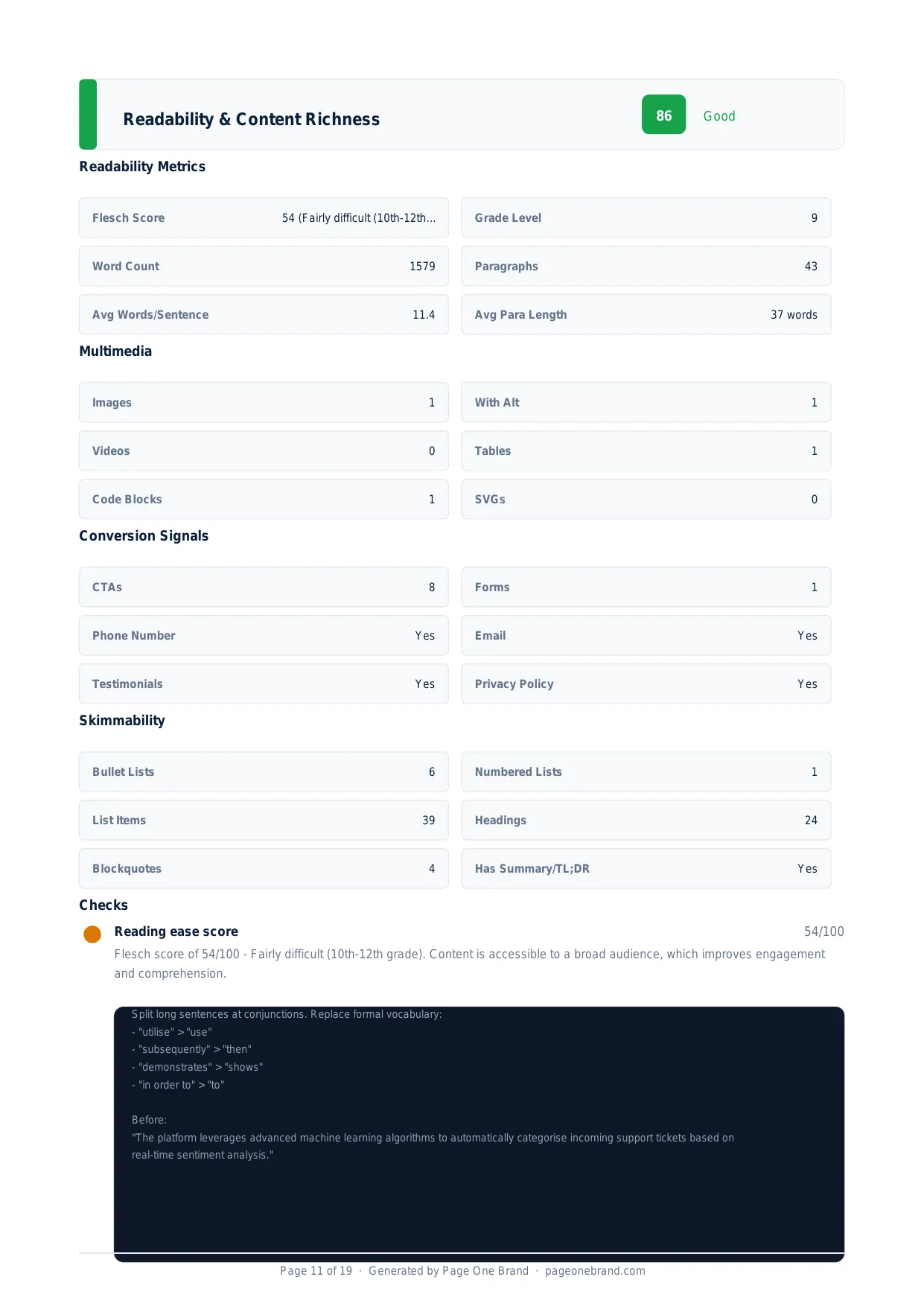
The Readability section of a real scan — showing Flesch reading ease score, grade level, sentence and paragraph length averages, and the multimedia and skimmability checks that make up Content Richness.
How We Calculate the Readability Score
The Readability and Content Richness score is a composite of reading ease metrics and content richness signals.
Reading ease metrics:
- Flesch Reading Ease score. Scores text on a 0-100 scale based on average sentence length and syllables per word. A score of 60-70 is appropriate for most web content. We check that your score falls in a range appropriate for a general web audience.
- Grade level (Flesch-Kincaid). Grade 6-8 is ideal for most web content. Grade 12+ signals academic complexity that most readers find effortful.
- Average sentence length. Sentences over 20 words become significantly harder to parse.
- Average paragraph length. Long paragraphs create visual density that discourages reading. Short paragraphs create white space that invites it.
Content richness signals:
- Images. At least one image with a descriptive alt text is expected. Pages with no images lose a richness point.
- Video embeds. A relevant video is one of the highest-impact content richness signals. Pages with embedded video typically see significantly longer session durations.
- Tables. Comparison tables and structured data in table form are highly skimmable and eligible for featured snippet extraction.
- Bullet and numbered lists. Lists break dense prose into scannable chunks.
- Headings density. Roughly one heading every 300-500 words is a useful benchmark.
- TL;DR or summary section. A clear summary serves readers who skim first and gives AI systems a quotable capsule of your content.
The Readability Trap
There is an important tension between readability and depth. Comprehensive, expert content tends to be complex. Stripping all complexity out to hit a Flesch target will often make content less useful and less authoritative.
The goal is not to minimise reading complexity at all costs. The goal is to express complex ideas as clearly as possible. Jargon that your audience knows is fine. Unnecessarily long sentences are not. Precise technical terms are appropriate. Passive voice constructions and bureaucratic formality are not.
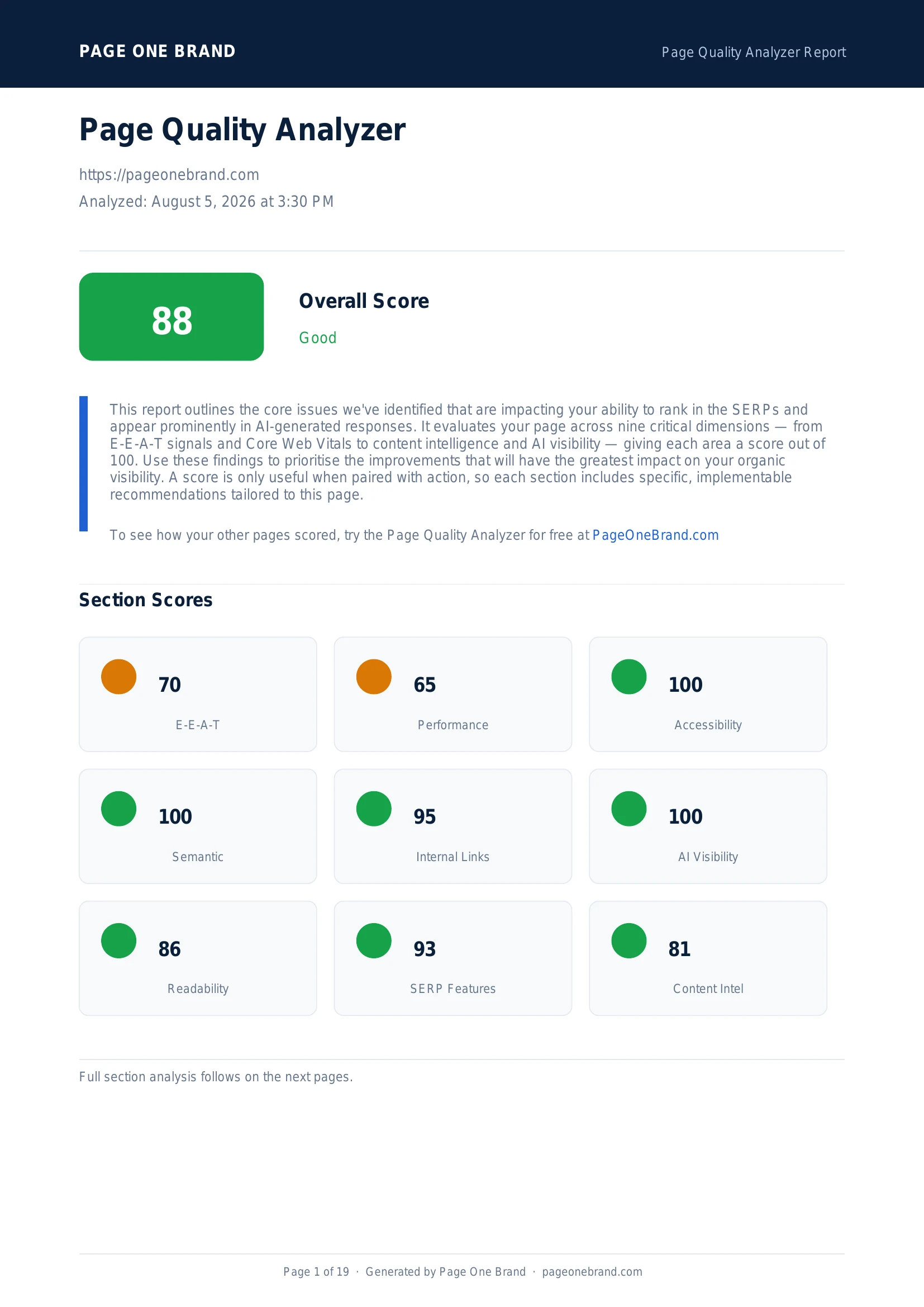 Readability interacts with E-E-A-T and Content Intelligence — deeper, more authoritative content tends to score higher on E-E-A-T but can face Readability pressure. The art is expressing complex ideas clearly.
How to Improve Your Readability Score
- Cut sentence length. Read your content aloud. Any sentence you cannot read in a single breath without pausing is too long. Break it into two.
- Replace long words with short ones. Utilise becomes use. Subsequently becomes then. Demonstrate becomes show.
- Break up long paragraphs. If any paragraph exceeds five sentences, look for a natural break point.
- Add at least one image with descriptive alt text. This is the single most common readability content-richness failure and takes five minutes to fix.
- Add a summary section. A brief TL;DR at the start, or a Key Takeaways section at the end, serves skimmers and AI systems equally well.
- Convert prose lists into bullet points. If a sentence lists three or more items, convert it to a bullet list.
Readability improvements have a higher return on investment than almost any other content optimisation because they simultaneously benefit users, search engines, and AI systems. The best version of your content is the clearest version — not the most complex one.
Frequently Asked Questions About Readability and Content Richness
What Flesch Reading Ease score should web content aim for?
A Flesch Reading Ease score of 60 to 70 is appropriate for most web content targeting a general audience. The scale runs from 0 (very difficult) to 100 (very easy), where 60–70 corresponds roughly to standard newspaper-level prose — accessible without being simplistic. A grade level of 6 to 8 on the Flesch-Kincaid scale is similarly ideal for most web content. Content consistently scoring below 50 (grade level 12+) is academic in complexity and typically loses readers who are not specialists in the subject. The goal is not to strip out all complexity — it is to express complex ideas as clearly as possible, which is achievable even for technical topics.
How does readability affect SEO performance?
The connection runs through user behaviour signals. Pages with lower reading complexity — shorter sentences, common vocabulary, clear paragraph breaks — keep users engaged longer, generate more scrolling, and produce lower bounce rates. These engagement signals are interpreted by Google's quality systems as evidence that the page satisfied the user's intent. Readability also affects AI citation likelihood: language models extract answers from content by identifying clear, self-contained statements, and concise precise prose is easier for LLMs to quote than convoluted writing. There is also a conversion dimension — unclear, jargon-heavy writing loses potential customers before they reach a call to action, which means readability improvements that help rankings also help the business outcomes the site is designed to achieve.
What content richness signals does the Page Quality Analyzer check?
The Page Quality Analyzer checks six content richness signals alongside the reading ease metrics: the presence of at least one image with descriptive alt text; video embeds (a relevant embedded video is one of the highest-impact richness signals — pages with video typically see significantly longer session durations); data tables (comparison tables and structured data are highly skimmable and eligible for featured snippet extraction); bullet and numbered lists (which break dense prose into scannable chunks); heading density relative to word count (roughly one heading every 300 to 500 words is a useful benchmark); and the presence of a TL;DR or summary section (which serves both skimmers and AI systems that prefer quotable capsule summaries).
Is there a tension between writing for readability and writing for depth and authority?
Yes, and it is a real design challenge. Comprehensive, expert content tends to be complex — detailed methodology explanations, precise technical terminology, and careful qualification of claims all improve E-E-A-T and Content Intelligence scores but raise reading grade level and Flesch complexity. The goal is not to minimise reading complexity at all costs. Stripping a technical topic down to a Flesch target of 80 can make content less useful and less authoritative. The goal is to express complex ideas as clearly as possible — using short sentences, active voice, and simple structure to carry complex content. Jargon that the target audience knows is appropriate. Unnecessarily long sentences, passive constructions, and bureaucratic formality are not. The best version of technical content is the clearest version of it.