SEO Strategy
How the Page Quality Analyzer Scores Your Page: A Complete Methodology Guide
By Robert Belkin, Founder & Lead Strategist
Published · 13 min read
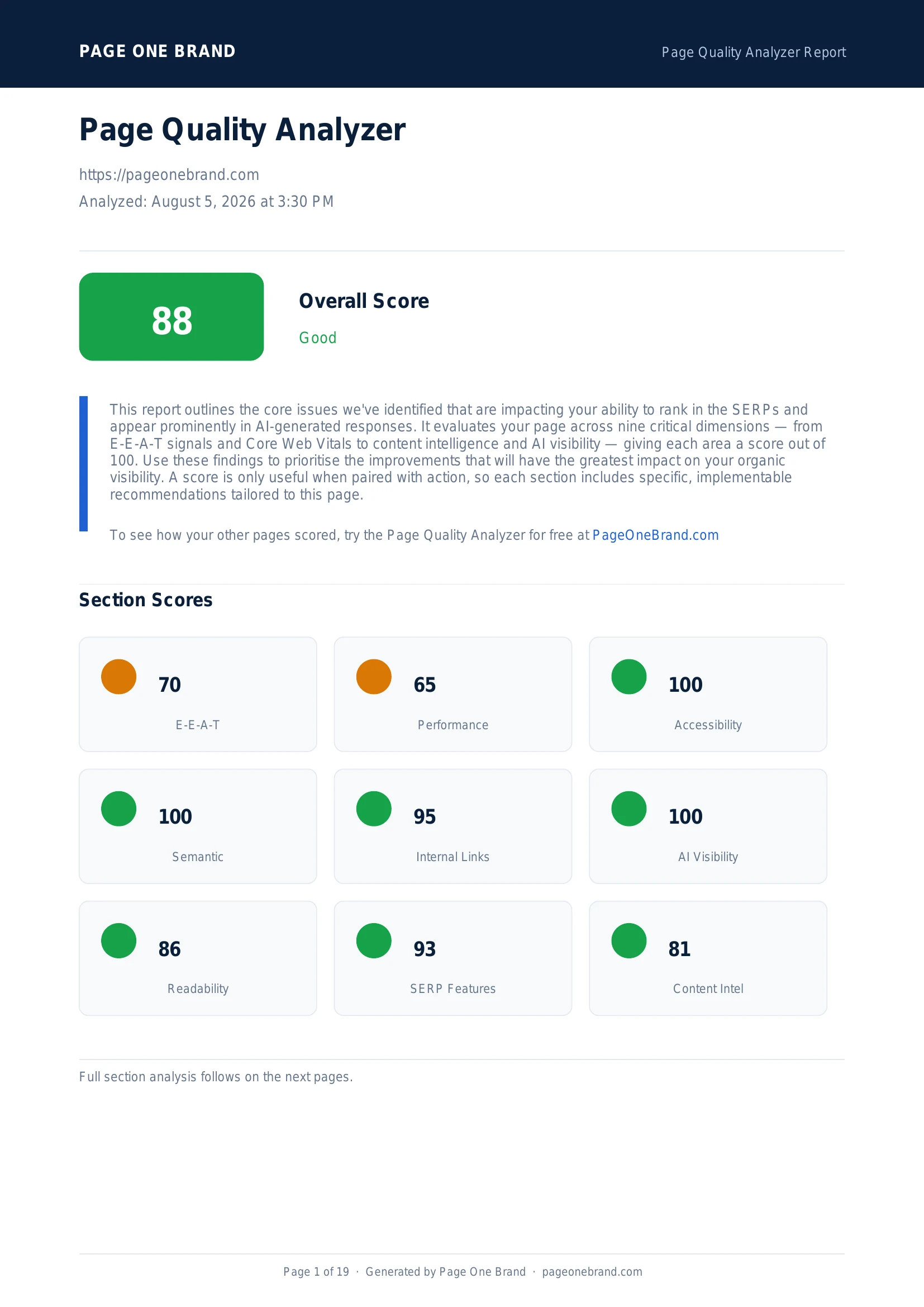
Every Page Quality Analyzer report reduces a complex, multi-factor assessment down to a single number. But that number is a composite — nine independent dimensions, each measuring a different aspect of page quality, each weighted and combined into one overall score. Understanding how we arrive at that number makes the report far more actionable.
This guide explains exactly how every dimension is scored, what data sources we use, and why each one is included. For each dimension, we link to a full in-depth guide that covers the methodology in detail and shows you how to improve your score.
A Page Quality Analyzer report showing all nine dimension scores — this guide explains exactly how each one is calculated.
How the Overall Score Is Calculated
The overall score is a weighted average of all nine dimension scores. Each dimension contributes differently to the total based on how strongly it correlates with long-term organic performance in our analysis. Dimensions that are harder to fake and more directly tied to ranking outcomes carry more weight.
E-E-A-T and Content Intelligence receive the highest weighting because they are the most predictive of ranking success and the hardest to manipulate. Technical dimensions — Performance, Accessibility, Semantic SEO, AI Visibility, Internal Linking — are fully deterministic and carry moderate weight. Readability and SERP Feature Readiness are important but more incremental in their ranking impact.
A score of 80 or above is a genuine benchmark that most pages do not reach. Getting to 90 requires clean passes across the dimensions that are structurally hard to improve — primarily Performance and E-E-A-T. What Your Page Quality Analyzer Score Actually Means explains these thresholds in detail.
How We Score E-E-A-T
E-E-A-T — Experience, Expertise, Authoritativeness, and Trustworthiness — is evaluated by GPT-4, prompted against Google's Search Quality Rater Guidelines. Each of the four sub-dimensions is scored independently on a 0-100 scale, then combined. The evaluation checks for named authors with verifiable credentials, original data or case studies, cited sources, institutional affiliations, company identity signals, and the presence of editorial standards. This is one of two dimensions that require AI evaluation — rule-based checks cannot reliably assess whether content demonstrates genuine expertise or trustworthiness.
Full guide: E-E-A-T Explained: What It Is and Why Google Uses It to Judge Your Page →
How We Score Performance
The Performance score is derived directly from Google's PageSpeed Insights API, called live for your URL at the time of the scan. The Lighthouse Performance score (0-100) is the primary input, adjusted based on Core Web Vitals threshold compliance: Largest Contentful Paint (LCP), Interaction to Next Paint (INP), and Cumulative Layout Shift (CLS). A page can score 70 in Lighthouse but still fail the Good threshold on INP — and that field-data failure carries the actual ranking consequence. The report surfaces specific improvement opportunities with estimated savings in kilobytes and milliseconds.
Full guide: Core Web Vitals and Page Speed: How Performance Affects Your Search Rankings →
How We Score Accessibility
The Accessibility score is derived from Google's Lighthouse Accessibility audit, called live via the PageSpeed Insights API. Lighthouse runs over 30 accessibility checks covering names and labels (alt text, ARIA labels, button text), navigation (keyboard focus, skip links, tab order), tables and lists, and semantic HTML. Each check is weighted by impact — missing alt text on a decorative image is a minor deduction, while a form with unlabelled inputs is a critical failure. A score of 100 is achievable and common on well-built pages.
Full guide: Web Accessibility and SEO: Why an Inclusive Site Scores Better in Search →
How We Score Semantic SEO
Semantic SEO is fully rule-based — every check has a deterministic pass or fail. We evaluate six groups: meta tags (title, description, canonical, robots, viewport), Open Graph tags (title, description, image, type), structured data (JSON-LD schema type detection and validation), H1 presence and uniqueness, heading hierarchy (no skipped levels), and HTML5 semantic elements (main, nav, header, footer, article, aside). The score is a weighted average across these groups. A score of 100 is realistically achievable in a single focused sprint.
Full guide: Semantic SEO: How Meta Tags, Schema Markup, and Page Structure Tell Google What You're About →
How We Score Internal Linking
The Internal Linking score assesses five dimensions of your link structure: internal link count, anchor text quality (descriptive vs. generic), empty or hash-only links, destination diversity (links spread across different pages vs. clustered on one), and the ratio of external to internal links. Each dimension is scored independently and combined into a weighted overall score. The checks are entirely based on the HTML of the page being analysed — no crawl of the wider site is required.
Full guide: Internal Linking Strategy: How Your Link Structure Signals Authority to Google →
How We Score AI Visibility
AI Visibility is fully rule-based with twelve specific checks. We verify that all major AI crawlers — GPTBot, OAI-SearchBot, ChatGPT-User, ClaudeBot, anthropic-ai, PerplexityBot, YouBot, Googlebot, Bingbot, CCBot, DuckAssistBot, and Bytespider — are permitted by robots.txt. We check for an llms.txt file (present, and substantive in length). We assess structured data richness (number of schema types), author metadata in tags and schema, publication date metadata, heading structure quality, and content depth signals including word count and factual statement density.
Full guide: AI Visibility: How to Get Your Content Cited by ChatGPT, Perplexity, and AI Search Engines →
How We Score Readability and Content Richness
The Readability score is a composite of reading ease metrics and content richness signals. Reading ease: Flesch Reading Ease score (target 60-70 for web content), Flesch-Kincaid grade level (target 6-8), average sentence length, and average paragraph length. Content richness: images with alt text, video embeds, tables, bullet and numbered lists, heading density relative to word count, and the presence of a summary or TL;DR section. Each signal is weighted and combined. The reading ease metrics are calculated from the extracted text content; the richness signals are parsed from the HTML structure.
Full guide: Readability and Content Richness: Why How You Write Is an SEO Signal →
How We Score SERP Feature Readiness
SERP Feature Readiness assesses schema signals and content structure signals. Schema signals: FAQPage, HowTo, Article or BlogPosting, BreadcrumbList, AggregateRating, and VideoObject JSON-LD. Content structure signals: a definition paragraph in the opening 35-100 words (featured snippet candidate), numbered step lists following headings (HowTo snippet candidate), comparison tables (table snippet candidate), question-format headings (People Also Ask candidates), and direct Q&A structure (question heading followed immediately by an answer paragraph). Each check is rule-based with clear pass or fail criteria.
Full guide: SERP Feature Readiness: How to Earn Featured Snippets, Rich Results, and People Also Ask →
How We Score Content Intelligence
Content Intelligence is the second GPT-4-evaluated dimension. It assesses five sub-scores: Search Intent match (does the content format and focus align with what users want when they search your target queries?), Information Gain (does the content add something not already available on top-ranking pages?), Entity Coverage (are the entities Google expects to see on high-quality pages about this topic present and substantively covered?), Topical Authority (does the page demonstrate depth and breadth of engagement with the subject?), and Competitive Depth (would this page stand out against what is already ranking?). Each sub-score is 0-100; the overall Content Intelligence score is their weighted average.
Full guide: Content Intelligence: The Advanced Analysis That Predicts Whether Your Content Will Rank →
Why Some Dimensions Are Harder to Improve Than Others
Seven of the nine dimensions are either fully rule-based (Semantic SEO, Accessibility, Internal Linking, AI Visibility, SERP Features) or derived from live third-party data (Performance from PageSpeed Insights, Readability from text analysis). These can all be improved with deterministic code and content changes.
E-E-A-T and Content Intelligence are different. Both require GPT-4 evaluation because the qualities they measure — genuine expertise, original insight, real-world authority — cannot be reliably assessed with rules. These dimensions are also the most strongly correlated with long-term organic performance, which is why they carry the highest weight in the overall score. They are the hardest to move and the most worth investing in.
If you are working through the report for the first time, start with the rule-based dimensions. Get Semantic SEO, Accessibility, AI Visibility, Internal Linking, and SERP Features to 90 or above first — these are fast wins. Then address Performance and Readability. Leave E-E-A-T and Content Intelligence for last, and plan for them to take time. Understanding what different score ranges mean will help you set realistic targets as you work through each dimension.
Frequently Asked Questions About the Scoring Methodology
How is the overall Page Quality Analyzer score calculated?
The overall score is a weighted average of all nine dimension scores. Each dimension is weighted based on how strongly it correlates with long-term organic performance. E-E-A-T and Content Intelligence receive the highest weighting because they are the most predictive of ranking success and the hardest to manipulate with surface-level optimisations. Technical dimensions — Performance, Accessibility, Semantic SEO, AI Visibility, Internal Linking — are fully deterministic and carry moderate weight. Readability and SERP Feature Readiness are important but more incremental in their ranking impact. A score of 80 or above is a genuine achievement that most pages do not reach; 90 requires clean passes across the structurally difficult dimensions.
Which dimensions use AI evaluation rather than rule-based checks?
Two of the nine dimensions are evaluated by GPT-4 rather than deterministic rules: E-E-A-T and Content Intelligence. E-E-A-T is prompted against Google's Search Quality Rater Guidelines and scores Experience, Expertise, Authoritativeness, and Trustworthiness sub-dimensions independently. Content Intelligence assesses Search Intent match, Information Gain, Entity Coverage, Topical Authority, and Competitive Depth. AI evaluation is used for these two because the qualities they measure — genuine expertise, original insight, real-world authority — cannot be reliably assessed with rules. The remaining seven dimensions are either rule-based with clear pass/fail criteria, or derived from live third-party data such as Google's PageSpeed Insights API.
Why do E-E-A-T and Content Intelligence carry the highest weight in the overall score?
They are weighted most heavily because they are the most strongly correlated with long-term organic performance and the hardest to fake. Rule-based checks can be gamed by adding schema markup, fixing meta tags, and adjusting heading structure — all valuable, but achievable without genuine quality improvement. E-E-A-T and Content Intelligence require substantive editorial investment: verifiable author credentials, original data, cited sources, genuine search intent matching, and information that competing pages do not already provide. These are the qualities Google's Helpful Content system is designed to surface and reward. A page that scores well on both is a page that is doing the hard work that sustainable rankings require.
What is the recommended order for tackling dimension improvements?
Start with the five rule-based dimensions: Semantic SEO, Accessibility, AI Visibility, Internal Linking, and SERP Feature Readiness. These have deterministic pass/fail checks and can often be improved to 90 or above in a single focused sprint. Then address Performance and Readability — Performance requires technical work but improvements are measurable and lasting; Readability benefits from structural content changes like shorter sentences, bullet lists, and added multimedia. Leave E-E-A-T and Content Intelligence for last. These are the most valuable dimensions for long-term organic performance but the slowest to improve — building verifiable expertise, publishing cited research, and earning a reputation for accuracy takes time and cannot be deployed in a sprint.